
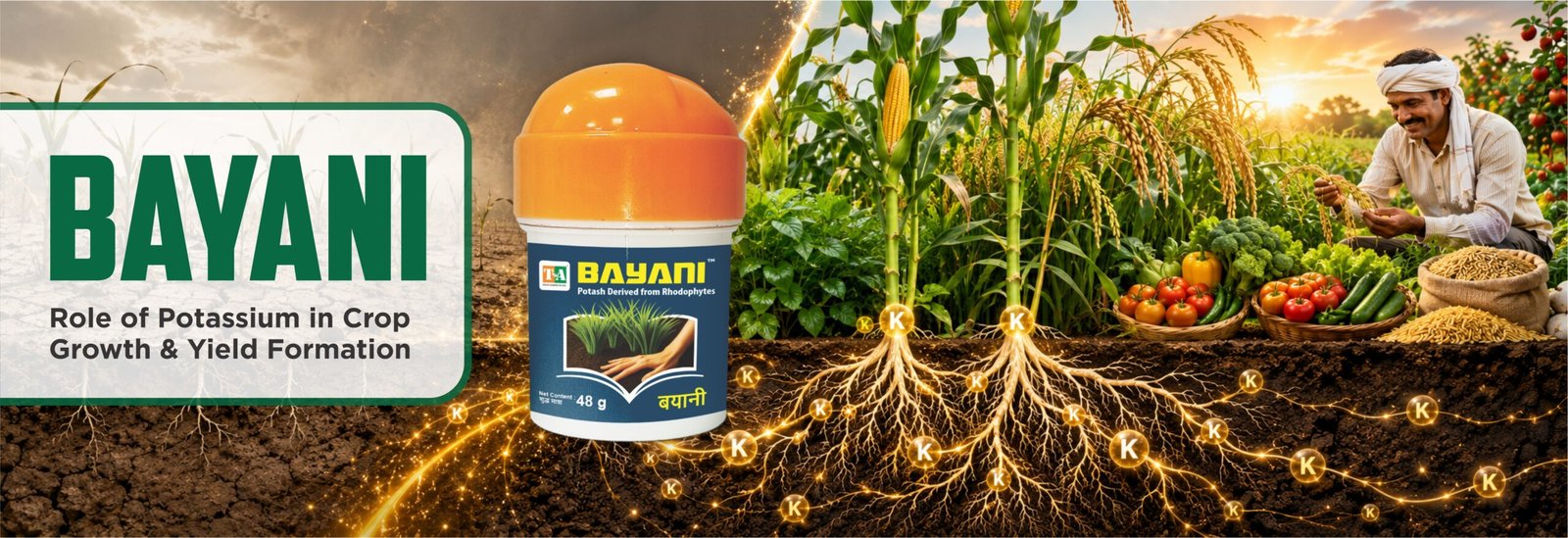
Potassium is often called a quality nutrient in agriculture because it does not directly build plant structure like nitrogen or phosphorus. Instead, it regulates how efficiently the plant system functions internally. From water balance to enzyme activation and movement of sugars, potassium controls processes that directly influence yield formation and produce quality.
BAYANI, derived from Rhodophytes (red seaweed source), is designed as a natural potassium-based input that supports balanced crop nutrition and improves plant performance during critical growth stages.
Why potassium is essential for plant functioning
Potassium does not become part of plant tissues structurally, but it plays a regulatory role inside plant cells.
It activates more than 60 enzymatic systems responsible for photosynthesis, protein synthesis, and energy transfer. Because of this, even when all other nutrients are available, potassium deficiency can slow down overall plant metabolism.
One of its most important functions is controlling stomatal activity. Stomata are microscopic pores on leaves that regulate gas exchange and water loss. Potassium helps these stomata open and close in a controlled manner, which improves water use efficiency and helps plants manage moisture stress more effectively.
Potassium is also responsible for transporting sugars produced in leaves to developing plant parts such as fruits, grains, and tubers. If this movement is restricted, plants may show good vegetative growth but poor yield formation.
Potassium and yield formation in crops
Yield is not only determined by how big the plant grows, but by how efficiently it converts nutrients into harvestable output.
Potassium plays a central role in this conversion process.
During flowering and reproductive stages, crop demand for potassium increases significantly. At this stage, potassium supports:
- Flower development and retention
- Fruit and grain filling
- Movement of carbohydrates to sink organs
- Strengthening of cell walls in developing produce
When potassium supply is balanced, crops show better grain weight, improved fruit size, and more uniform maturity. In contrast, deficiency often leads to weak grain filling, poor quality produce, and reduced post-harvest shelf life.
Role of Rhodophyte-derived potassium
Potassium derived from Rhodophytes is not just a mineral source. It is associated with naturally occurring bioactive compounds from marine algae origin.
These compounds support nutrient uptake efficiency and improve metabolic activity inside the plant system. As a result, plants are able to utilize applied nutrients more effectively compared to conventional sources alone.
This improves overall nutrient use efficiency, which is increasingly important in modern farming where input cost optimization and yield stability both matter.
Potassium and stress tolerance in crops
Crops are regularly exposed to environmental stress such as drought, high temperature, salinity, and disease pressure.
Potassium helps plants respond to these stresses by maintaining internal cell pressure (turgor) and regulating water movement inside plant tissues. During water scarcity conditions, potassium reduces unnecessary water loss by controlling stomatal function. During heat stress, it helps stabilize enzymatic activity and reduces physiological imbalance inside the plant.
Because of this role, potassium is strongly linked with crop resilience and yield stability under changing field conditions.
Field-level response of balanced potassium nutrition
When potassium levels are adequate, changes are visible in plant behavior and crop performance.
Farmers generally observe:
- Stronger and more uniform plant growth
- Stable leaf color during active growth stages
- Better flowering consistency
- Improved fruit and grain development
In fruit and vegetable crops, potassium improves color development, taste, and marketable quality. In cereal crops, it supports better grain filling and reduces shriveled grains.
Its effect becomes most visible during reproductive stages when nutrient demand is at its peak.
Conclusion
Potassium is not a growth-promoting nutrient in isolation, but a functional nutrient that regulates how efficiently a plant uses all other nutrients. It influences water balance, enzyme activity, and carbohydrate movement, all of which directly affect final yield and quality.
BAYANI (Potash Derived From Rhodophytes) provides a potassium source supported by natural seaweed-derived compounds that help improve nutrient uptake and plant metabolic efficiency. When included in a balanced crop nutrition program, it supports stronger plant performance, better stress tolerance, and improved yield consistency during critical growth stages.