
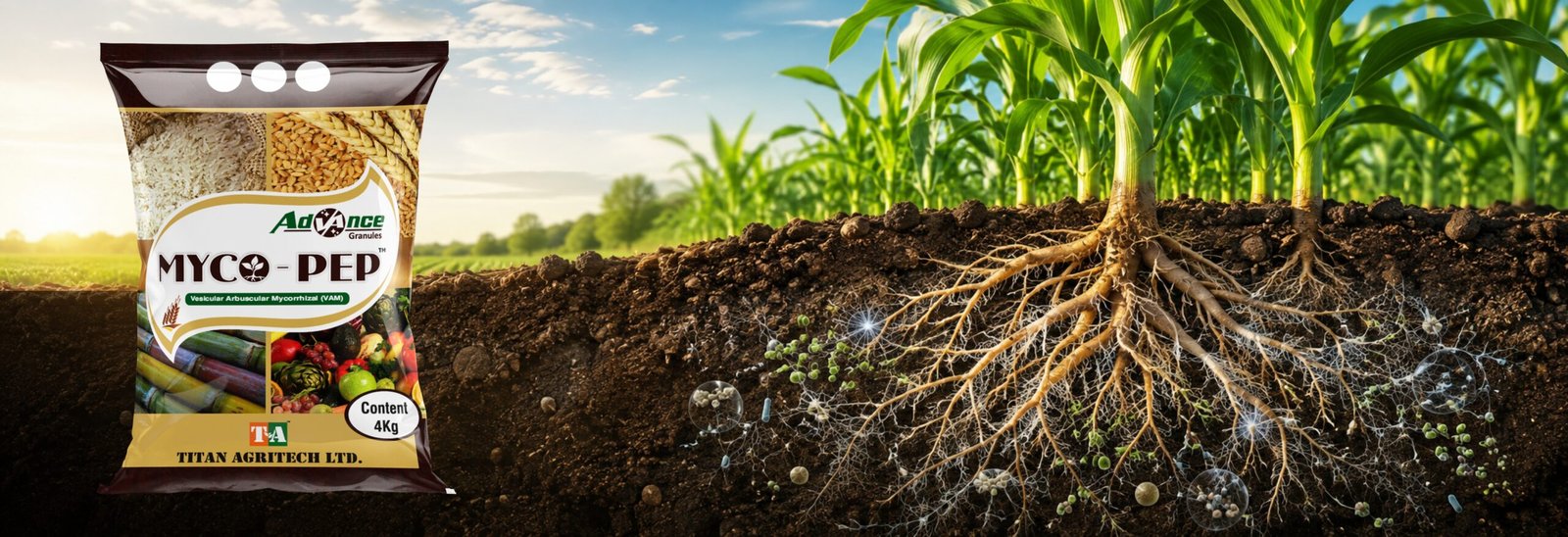
10 Ways Mycorrhiza Builds a Healthier Root Zone
A farmer applies fertilizer on time, irrigation is available, and the crop looks healthy from above, yet growth may still fall short of expectations.
A common question in the field is:
“Fertilizer has been applied to the soil, so why isn’t the crop getting its full benefit?”
The answer may sometimes lie below the soil surface.
Roots need more than fertilizer to perform efficiently. They need adequate moisture, oxygen, physical space, accessible nutrients, and a biologically active environment. The zone surrounding the roots, known as the rhizosphere, plays an important role in bringing these factors together. This is where Mycorrhiza and beneficial microorganisms can become valuable components of modern crop and soil management.
The Nutrient Is in the Soil. But Is It Available to the Root?
Consider a farmer growing maize. Phosphorus fertilizer is applied during crop establishment to support early root development and healthy crop growth. Yet, even with adequate fertilizer application, the crop may sometimes show slower root development or weaker early growth.
This does not necessarily mean that phosphorus is missing from the soil.
Phosphorus has relatively low mobility in soil and can become associated with calcium, iron, or aluminium compounds depending on soil properties. A portion of the nutrient can therefore become less accessible to plant roots.
The same principle applies to several other nutrients.
A nutrient being present in the soil does not always mean that the plant can access it efficiently.
This is why modern crop nutrition is increasingly looking beyond the quantity of fertilizer applied and focusing on nutrient availability, root exploration, and nutrient use efficiency.
What Is Happening Around the Roots?
The rhizosphere is the biologically active zone directly influenced by plant roots. Roots release compounds such as sugars, amino acids, and organic acids into the surrounding soil. These compounds influence microbial activity and create a dynamic environment around the root. At the same time, microorganisms interact with roots, soil particles, organic matter, water, and nutrients.
A functional root zone therefore depends on several factors working together:
Healthy roots + accessible nutrients + adequate moisture + good soil structure + beneficial microbial activity
When one or more of these factors are limited, nutrient uptake and root development can also be affected.
How Mycorrhiza Extends the Functional Root System
One of the natural limitations of roots is their physical reach.
Mycorrhizal fungi can help extend this functional reach. In arbuscular mycorrhizal associations, fungi such as Rhizophagus colonize plant roots and develop microscopic structures called hyphae that extend into the surrounding soil. These hyphae are much finer than roots and can explore soil pores and microsites beyond the immediate root zone.
A simple way to understand this is:
Plant roots explore the soil. Mycorrhizal hyphae extend that exploration further.
This becomes particularly relevant for relatively immobile nutrients such as phosphorus.
The fungus obtains carbon from the plant, while the fungal network contributes to nutrient and water acquisition. This makes mycorrhiza a symbiotic association, rather than simply another source of nutrients.
Why Does This Matter for Phosphorus?
Phosphorus is involved in several critical plant processes, including:
- Energy transfer through ATP
- Root development
- Nucleic acid synthesis
- Cell membrane formation
- Flowering and reproductive development
However, phosphorus moves slowly through many soils.
As roots absorb available phosphorus, a depletion zone can develop around the root surface. The plant may then have limited access to phosphorus located farther away. Mycorrhizal hyphae can extend beyond this depletion zone and explore additional soil microsites. The phosphorus acquired through this network can then be transferred towards the colonized root.This can complement the plant’s own root system and support phosphorus acquisition under suitable soil and environmental conditions.
A Simple Field Example
Consider a vegetable field where the farmer has applied the recommended fertilizer, but the crop develops a relatively small root system and begins showing stress quickly when moisture fluctuates.
There may be several possible reasons, including soil compaction, poor aeration, nutrient imbalance, salinity, or restricted root development.
Now consider the role of the root zone.
A plant with a more active and well-developed root system can explore a greater volume of soil. Where compatible conditions exist, mycorrhizal hyphae can further extend this exploration beyond the immediate root surface.
The objective is not to assume that Mycorrhiza will solve every field problem. Instead, it is to understand that root development and nutrient acquisition depend on both the plant and its surrounding biological environment.
This is why biological inputs work best as part of an integrated crop management programme.
When Is Mycorrhiza Most Relevant?
Timing matters because mycorrhizal fungi need to establish an association with developing roots.
In many cropping systems, introducing Mycorrhiza early enough to interact with actively developing roots can be advantageous, subject to the crop, formulation, application method, and field conditions. The objective is to establish the biological association while the root system is developing, rather than treating Mycorrhiza simply as a late-season corrective input.
This is particularly relevant during crop establishment and early root development, when the plant is building the root system that will support nutrient and water acquisition later in the season.
Mycorrhiza Is Only One Part of the Root-Zone Biology
A healthy rhizosphere contains a diverse microbial community. Beneficial bacteria can contribute to different functions depending on the microbial species and strain. Some phosphate-solubilizing microorganisms can produce organic acids and enzymes that help release phosphorus from poorly available forms. Certain microorganisms can contribute to the biological transformation of nitrogen, while others may participate in the mobilization of nutrients such as potassium and zinc. Plant growth-promoting microorganisms can also influence root architecture and plant physiological processes through compounds, enzymes, siderophores, and signalling mechanisms.
The important point is that these microorganisms do not all perform the same function.
Mycorrhiza, beneficial bacteria, roots, and soil organic matter can contribute different functions within the same root-zone ecosystem.
What Does a Healthy Root Zone Look Like?
Farmers often judge crop health by looking at the leaves, but some of the most important changes begin underground.
A functional root zone generally supports:
Active root growth
Roots should be able to penetrate and explore the available soil volume.
Good soil aeration
Roots require oxygen for respiration and normal metabolic activity.
Balanced moisture
Adequate moisture supports nutrient movement, while excessive water can reduce oxygen availability.
Accessible nutrients
Nutrients need to be present in chemical forms and locations that roots can access.
Biological activity
Beneficial microorganisms contribute to nutrient cycling and interactions around roots.
Good soil structure
Adequate pore space supports root penetration, water movement, and gas exchange.
When these conditions come together, the plant has a more supportive environment for root development and resource acquisition.
What Happens When Roots Are Under Stress?
Environmental stress makes root-zone functionality even more important.
During drought, roots face reduced water availability. In poorly drained soil, excessive water can reduce oxygen around the root system. Soil salinity can create additional osmotic and ionic stress. These conditions can interfere with nutrient uptake and root activity.
Under suitable conditions, mycorrhizal hyphae can explore soil microsites beyond the immediate root surface and may contribute to water and nutrient acquisition. Beneficial microorganisms can also influence root development and plant responses associated with environmental stress.
However, these effects are not universal. Performance depends on crop species, microbial strain, colonization level, soil properties, nutrient status, and environmental conditions.
Soil Structure Matters Too
Biology alone cannot compensate for poor physical soil conditions.
Compacted soil can restrict root penetration, reduce pore space, limit oxygen movement, and interfere with water infiltration. Mycorrhizal hyphae can contribute to soil aggregation by interacting with soil particles and organic compounds. Fungal structures and compounds associated with fungal activity can influence aggregate stability. Better aggregation can contribute to a more favourable physical environment for roots and microorganisms.
However, severe compaction still requires appropriate agronomic management through suitable tillage, organic matter management, drainage, and irrigation practices.
Healthy Soil Is More Than NPK
For practical crop production, soil fertility is often discussed in terms of nitrogen, phosphorus, and potassium. These nutrients are essential, but productive soil is more than an NPK reservoir.
A functional root zone also depends on:
- Good soil structure
- Balanced moisture
- Adequate organic matter
- Active microbial communities
- Suitable soil pH
- Proper aeration and drainage
- Balanced crop nutrition
- Healthy root development
When these factors work together, soil becomes more than a place where fertilizer is applied.
It becomes a biologically active environment that supports root growth, nutrient cycling, and efficient resource acquisition.
Where Do Biological Inputs Fit Into Crop Nutrition?
The role of biological products becomes clearer when viewed from this perspective.
The objective is not to position Mycorrhiza or beneficial microorganisms as direct replacements for fertilizers. Fertilizers supply essential nutrients in the quantities required by the crop. Biological inputs can support the biological processes that influence how nutrients are accessed, mobilized, and utilized.
For farmers, biologicals can therefore be considered as part of an integrated soil and crop nutrition programme, particularly where nutrient fixation, restricted root development, low biological activity, or environmental stress is limiting crop performance.
For dealers, this also creates a more useful way to discuss biological products with farmers.
Instead of asking only:
“How much fertilizer should be applied?”
the conversation can also ask:
“How efficiently can the crop access and utilize the nutrients already present in the soil?”
That shift moves the discussion from simply selling another input towards building a more complete crop nutrition programme.
Building a More Functional Root Zone
A healthier root zone is not created by one product alone.
It develops through the interaction of several management practices:
- Healthy and active roots
- Functional mycorrhizal colonization
- Beneficial microbial activity
- Balanced fertilizer application
- Adequate organic matter
- Proper soil moisture
- Good aeration and drainage
- Suitable soil pH
- Appropriate crop management
- Reduced unnecessary soil disturbance
Mycorrhiza and beneficial microorganisms become one part of this larger system.
The goal is to create conditions where roots, nutrients, soil structure, and beneficial microorganisms can function together.
Conclusion
A crop does not perform simply because fertilizer has been applied.
Its performance also depends on whether roots can effectively explore the soil, access available nutrients, maintain physiological activity, and function within a supportive root-zone environment.
Mycorrhiza can extend the functional reach of roots through its external hyphal network, particularly supporting the acquisition of relatively immobile nutrients such as phosphorus. Beneficial microorganisms can contribute to nutrient mobilization, root development, nutrient cycling, and plant-microbe interactions.
The practical takeaway for farmers is simple:
Healthy roots need a healthy root zone.
For modern crop nutrition, the focus is no longer only on how much nutrient is added to the soil. It is also about creating the conditions that help crops access, acquire, and utilize those nutrients efficiently.
Healthy Soil → Active Rhizosphere → Stronger Roots → Better Crop Potential