
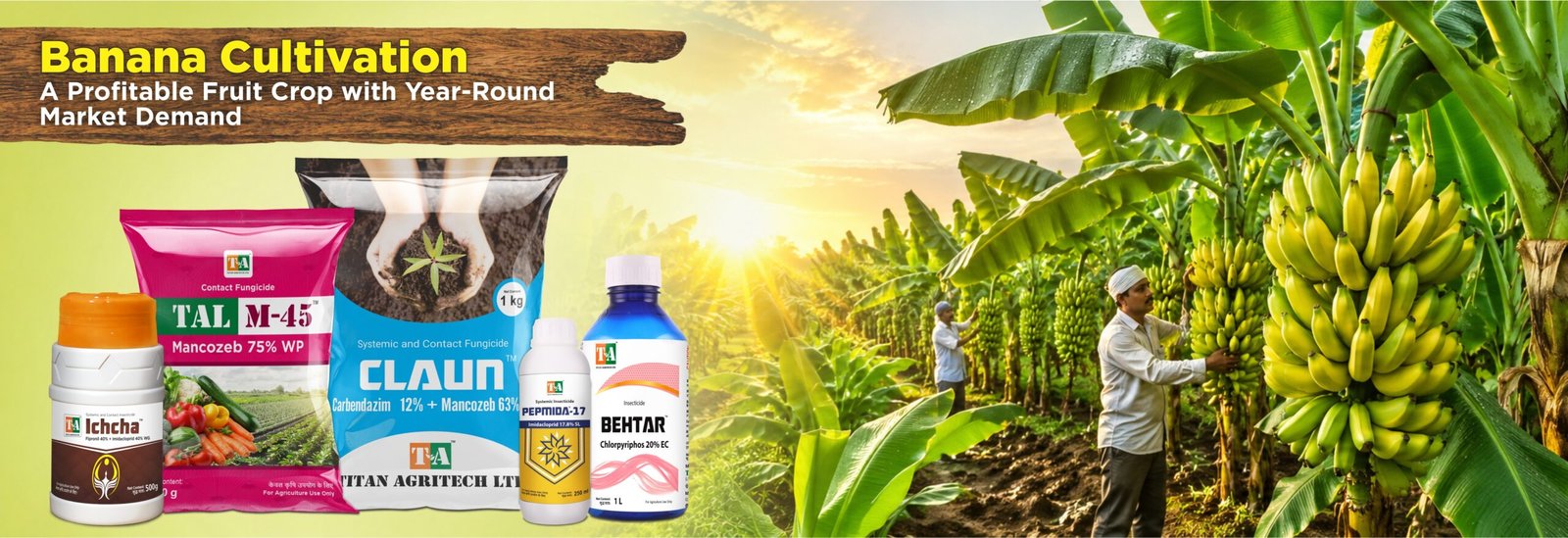
Banana is considered one of the most important fruit crops in India. After mango, it is among the most widely cultivated fruit crops in the country. One of its biggest advantages is its consistent market demand throughout the year, which provides farmers with regular income opportunities.
Banana is valued not only for its taste but also for its nutritional benefits. It contains a good amount of carbohydrates, Vitamin B, potassium, and several essential nutrients. Because of this, its use is rapidly increasing not only as a fresh fruit but also in processed products such as chips, puree, juice, and other value-added products.
Today, many farmers are adopting banana cultivation on a commercial scale because, with proper crop management, it can provide stable and long-term economic returns.
Suitable Climate and Soil for Banana Cultivation
Bananas grow well in warm and humid climatic conditions. Areas that are free from severe cold and frost are considered ideal for banana farming. Balanced temperature and adequate moisture are important for vigorous plant growth and proper bunch development.
Deep loamy, silt-rich, and well-drained soils are considered most suitable for banana cultivation. Waterlogging should be avoided because excess moisture affects root development and increases the risk of several diseases.
A soil pH between 6 and 7.5 is generally considered ideal for banana cultivation.
Land Preparation for Banana Farming
Proper land preparation is essential for successful banana cultivation. The field should be ploughed deeply 3 to 4 times to make the soil loose and friable, which helps in better root development.
During the final ploughing, well-decomposed farmyard manure should be incorporated into the soil to improve soil fertility. Many farmers also use 4 kg/acre of Mycopep (Mycorrhiza GR), a mycorrhiza-based product, to support stronger initial root development.
Pits of 45×45×45 cm or 60×60×60 cm size are generally prepared for transplanting. Mixing farmyard manure and neem cake in the pits helps improve early plant establishment and growth.
Right Time and Method of Transplanting
Banana transplanting is generally considered suitable between February and March. Selecting healthy and disease-free planting material is very important because strong plants are the foundation of higher productivity.
Proper spacing between plants is necessary to maintain good sunlight penetration and air circulation. A spacing of approximately 1.8 × 1.8 meters is commonly recommended.
Plants should not be transplanted too deep into the soil, as deep planting may negatively affect root development.
Plant Treatment and Crop Protection
Plant treatment plays an important role in protecting banana crops from diseases and nematode infestations. Before transplanting, treating the roots with a TRICHO-PEP H solution helps reduce the risk of early-stage infections.
Many farmers also use 10 gm/liter of water of CLAUN (Carbendazim 12% + Mancozeb 63% WP) to manage problems such as Fusarium wilt and root rot.
Balanced Nutrition Improves Yield
Banana is considered a heavy nutrient-feeding crop, so balanced nutrition is essential for healthy growth and better bunch development.
In the initial stages, organic manure helps strengthen the root system, while balanced application of nitrogen, phosphorus, and potash supports plant growth and fruit formation.
FABIANA (Bio-NPK Liquid) helps provide essential nutrients to the crop, supporting balanced plant growth and maintaining crop health for a longer period. Its application along with micronutrients can improve fruit size, shine, and overall quality.
Proper Irrigation Management is Important
Banana roots do not grow very deep, so the crop requires regular moisture throughout its growth period. Timely irrigation during summer improves plant growth and fruit development.
Generally, irrigation at intervals of 4 to 5 days during summer and 7 to 8 days during winter is considered beneficial.
Many farmers are now adopting drip irrigation systems because they help save water and improve fertilizer use efficiency.
Why Weed Management is Necessary
Weeds compete with banana plants for nutrients and moisture, which directly affects plant growth and productivity. Therefore, timely weeding and intercultural operations are important.
Some farmers also use herbicides during the initial stages to keep the field weed-free for a longer period.
Major Insect Pests and Their Management
| Pest | Damage | Control |
| Rhizome Weevil | Damages roots and stems, weakening the plants | Apply BEHTAR (Chlorpyriphos 20% EC) at 600-800 ml/acre |
| Aphids | Suck plant sap and reduce plant vigor | Spray PEPMIDA-17 (Imidacloprid 17.8% SL) at 40-50 ml/acre |
| Thrips | Damage leaves and fruits | Apply ICHCHA (Fipronil 40% + Imidacloprid 40% WG) at 30-40 gm/acre |
Major Diseases and Their Management
| Disease | Identification | Management |
| Sigatoka Leaf Spot | Brown spots appear on leaves | Spray TAL M-45 (Mancozeb 75% WP) at 600-800 gm/acre |
| Panama Wilt | Plants start wilting and growth slows down | Apply CLAUN (Carbendazim 12% + Mancozeb 63% WP) at 700 gm/acre |
| Anthracnose | Black spots appear on fruits and leaves | Spray CHLOPER (Copper Oxychloride 50% WP) at 1000 ml/acre |
| Fusarium Wilt | Plants begin drying and roots get affected | Remove infected plants and maintain field sanitation |
Harvesting and Yield
Banana plants are generally ready for harvesting about 11 to 12 months after transplanting. Harvesting should be done when the fruits are fully developed and attain uniform size.
For local markets, fruits are harvested at the ripening stage, while for distant markets, harvesting at the semi-mature stage is considered more suitable.
Farmers who follow balanced nutrition, proper irrigation, and timely disease management practices can achieve better quality produce and higher yields.
Conclusion
Banana cultivation is considered a highly profitable fruit farming option that provides farmers with regular income over a long period. Its demand remains stable throughout the year, and its use in processing industries is also increasing steadily.
With the selection of improved varieties, balanced nutrition, proper irrigation, and effective crop protection practices, banana cultivation can become a strong and sustainable commercial farming option for farmers.