
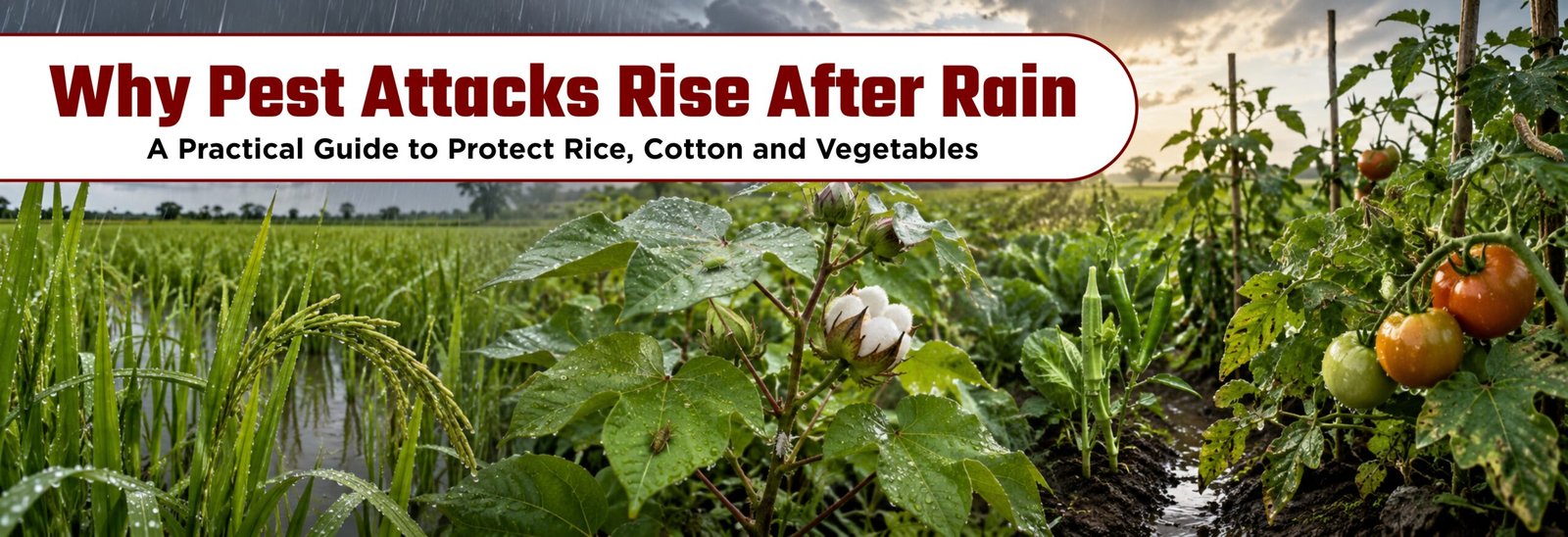
Powerful Ways to Prevent Pest Attacks After Rain: A Smart Guide to Protect Rice, Cotton & Vegetables
Rain is essential for crop growth, but the conditions created after rainfall can also increase pest activity. Farmers often notice more insects in the field a few days after continuous or heavy rain. This does not happen simply because it rained. Rainfall changes humidity, temperature, plant growth, soil moisture and crop canopy conditions, which together can create a favourable environment for several insect pests.
This becomes particularly important in Rice, Cotton and Vegetables, where rapid vegetative growth after rainfall can provide fresh feeding sites for insects.
What Happens to the Crop After Rain?
After rainfall, soil moisture increases and plants may resume active growth. New leaves, shoots and tender tissues develop quickly when moisture and temperature are favourable.
At the same time, humidity inside a dense crop canopy can remain high. Leaves stay moist for longer, air movement may be reduced and insects can find sheltered areas around leaves, stems and growing points.
The result is a change in the crop microclimate.
Rainfall → higher moisture → fresh plant growth → humid canopy → favourable pest conditions
Why Do Pest Populations Increase After Rain and Pest Attacks?
1. Higher Humidity Supports Pest Development
Temperature and relative humidity strongly influence insect development. Under suitable conditions, they can affect egg hatching, nymphal development, survival and reproduction.
After rainfall, warm and humid conditions may therefore favour certain pests, particularly when the crop canopy is dense.
In rice, this can create favourable conditions for pests such as brown planthopper and leaf folder. Cotton may experience increased pressure from jassids and whiteflies, while vegetables can face problems from aphids, whiteflies, thrips and caterpillars.
The actual pest response depends on species, temperature, crop stage and local field conditions.
2. Fresh Growth Provides Better Feeding Sites
Rainfall often stimulates new vegetative growth.
Tender leaves and shoots can become attractive feeding sites for several insect pests. Sucking pests, for example, commonly concentrate around young and actively growing tissues.
This explains an important observation in agriculture: a crop can look greener and healthier after rain while simultaneously becoming more favourable for pest development.
3. Dense Canopies Provide Shelter from Pest Attacks
As plants grow rapidly, the canopy becomes denser.
Dense foliage can increase humidity and provide insects with protected locations. Some pests remain on the underside of leaves or around stems where they are less exposed to direct environmental conditions.
This is why post-rain scouting should not focus only on the visible upper surface of leaves.
Crop-Wise Pest Risk After Rain
Rice
Rice fields can develop a warm and humid microclimate, especially under dense planting and excessive vegetative growth. Brown planthopper deserves particular attention because it feeds at the base of rice tillers and can multiply rapidly under favourable conditions. Where brown planthopper pressure requires intervention, DIPPOT (Dinotefuran 15% + Pymetrozine 45% WG) can be used according to the recommended dose and label directions.
Leaf folders can also become noticeable when foliage is dense and humid. Folded leaves and scraped leaf surfaces are useful indicators during field scouting. For leaf folder management, SANHAAR (Novaluron 5.25% + Indoxacarb 4.5% SC) can be used according to the recommended crop stage, dose and label directions.
After rainfall, farmers should therefore inspect the base of tillers, leaf undersides and folded leaves rather than relying only on general field appearance.
Cotton
Rainfall can stimulate fresh vegetative growth in cotton when soil moisture becomes favourable. This can influence populations of sucking pests such as jassids and whiteflies. For their management, ICHCHA (Fipronil 40% + Imidacloprid 40% WG) and PEPMIDA-70 (Imidacloprid 70% WG) can be used according to the recommended crop stage, dose and label directions.
Young leaves should be examined carefully for feeding symptoms and pest populations, particularly on the underside. As cotton moves towards flowering and boll development, monitoring should also include squares, flowers and developing bolls, because pest damage to reproductive structures can directly affect yield.
Vegetables
Vegetable crops can respond quickly to changes in moisture and temperature because they continuously produce young tissues. After rainfall, pests such as aphids, whiteflies, thrips and caterpillars may become more active depending on the crop and prevailing weather.
For sucking pests such as aphids, whiteflies and thrips, ICHCHA (Fipronil 40% + Imidacloprid 40% WG) and PEPMIDA-70 (Imidacloprid 70% WG) can be considered according to the registered crop, pest, recommended dose and label directions. For caterpillar pests, SANHAAR (Novaluron 5.25% + Indoxacarb 4.5% SC) can be used where registered and recommended.
Regular inspection of growing points, young leaves, leaf undersides, flowers and developing fruits is important because pest populations can build quickly in short-duration vegetable crops.
Does Rain Mean Farmers Should Spray Immediately?
Not necessarily.
Rainfall should be considered a signal for closer monitoring, not an automatic reason for insecticide application.
Before taking a control decision, farmers should identify:
- Which pest is present?
- How high is the pest population?
- Which crop stage is affected?
- Is the pest population increasing?
- Are natural enemies present?
- Has the pest reached the locally recommended economic threshold?
This approach helps avoid unnecessary applications while allowing timely intervention when pest pressure is genuinely increasing.
What About Plant Nutrition After Rain?
Pest management does not work independently from crop nutrition.
Excessive nitrogen can encourage lush and succulent vegetative growth, which may increase susceptibility to certain sucking pests under favourable conditions. On the other hand, balanced nutrition supports normal plant development and helps maintain overall crop performance.
After periods of heavy rainfall, attention should therefore be given to balanced nutrition, root activity and plant recovery, along with pest monitoring.
Amino acid-based biostimulants can be incorporated into crop nutrition programmes where appropriate to support plant physiological processes during periods of environmental stress.
Similarly, a healthy rhizosphere is important because rainfall can influence soil aeration, nutrient availability and root activity. Mycorrhizal associations and beneficial microorganisms can support the root-zone environment and nutrient acquisition as part of an integrated crop management programme.
A Practical Post-Rain Approach
A simple strategy can help farmers respond more effectively:
Observe: Inspect the crop after significant rainfall.
Identify: Determine the pest instead of treating symptoms alone.
Assess: Check pest population, crop stage and affected plant parts.
Act: Use the appropriate registered control measure when intervention is justified.
The objective is not to spray because it rained. The objective is to identify the biological changes created by rainfall and respond before pest pressure becomes economically significant.
Conclusion
Rainfall can create a temporary shift in the crop ecosystem. Increased humidity, fresh plant growth, dense foliage and favourable temperature can provide conditions that support pest activity.
For Rice, Cotton and Vegetables, the days following rainfall are therefore an important period for field scouting.
Early detection, balanced crop nutrition, healthy root-zone management and need-based pest control can help farmers manage post-rain pest pressure more effectively and protect crop growth throughout the season.