
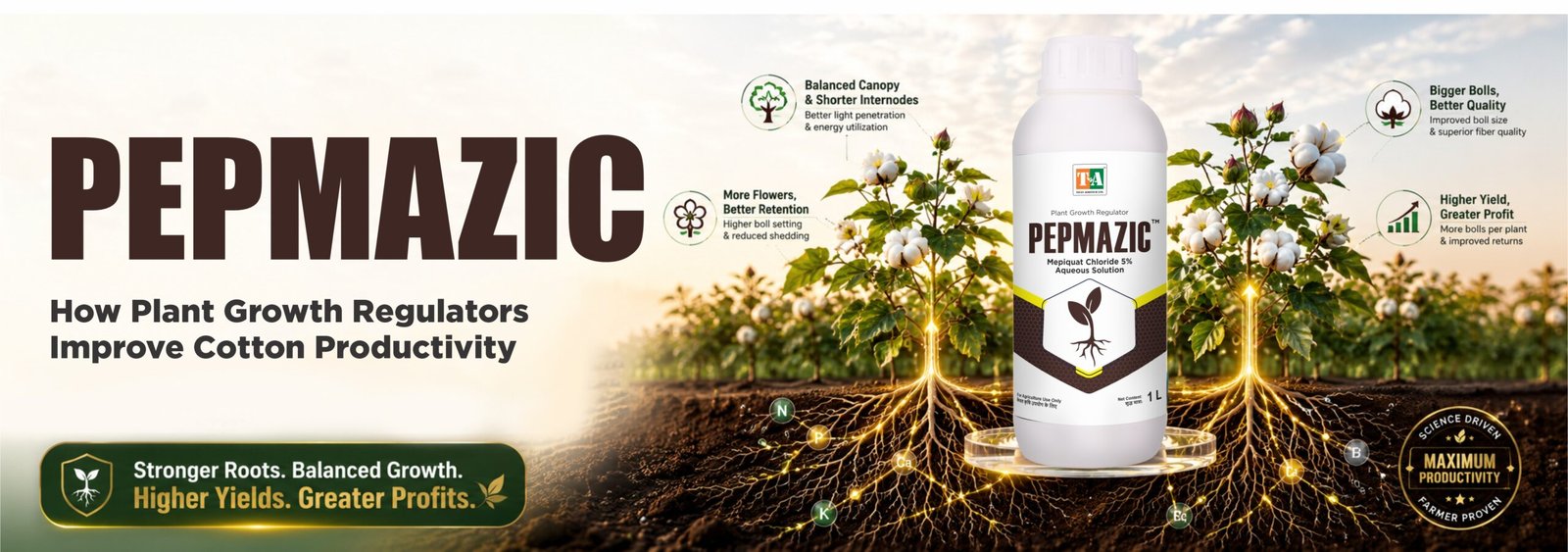
 Cotton is a crop with tremendous yield potential, but achieving that potential depends on how effectively the plant balances vegetative growth and reproductive development. In many cotton-growing regions, farmers often encounter a common challenge during the season: the crop becomes excessively vegetative. The field appears lush and healthy, plants grow taller, and foliage becomes denser. While this may seem like a sign of strong crop growth, excessive vegetative development can actually limit productivity.
Cotton plants require a balance between canopy formation and boll production. When the crop directs too much energy toward stem elongation and leaf development, fewer resources remain available for square formation, flowering, boll retention, and boll development. As a result, the crop may produce a large amount of biomass without a proportional increase in yield.
This is where Plant Growth Regulators (PGRs) play an important role in modern cotton cultivation.
Understanding the Problem of Excessive Vegetative Growth
Cotton naturally produces growth hormones known as gibberellins, which stimulate cell elongation and vegetative growth. Under favorable growing conditions, especially when nitrogen availability is high, irrigation is adequate, and weather conditions support rapid growth, gibberellin activity increases significantly.
The result is excessive plant height, longer internodes, dense canopy formation, and delayed crop maturity. As the canopy becomes thicker, sunlight penetration into the lower portions of the plant decreases. Reduced air movement inside the crop creates a humid microclimate that can favor pest and disease development.
More importantly, excessive vegetative growth creates internal competition within the plant. Nutrients, water, and photosynthates that should support flowering and boll formation are increasingly diverted toward new vegetative growth. This often leads to square shedding, poor boll retention, and uneven crop development.
In high-yield cotton systems, managing this vegetative vigor is often as important as supplying nutrients.
What is PEPMAZIC (Mepiquat Chloride 5%)?
PEPMAZC contains Mepiquat Chloride 5%, a widely recognized plant growth regulator used in cotton cultivation across the world. Unlike fertilizers that supply nutrients, Mepiquat Chloride influences the plant’s internal growth processes.
Its primary role is to regulate gibberellic acid synthesis within the plant. By moderating gibberellin activity, it reduces excessive cell elongation and helps maintain a more compact and productive crop structure.
The objective is not to stop plant growth. Instead, the goal is to improve growth efficiency by directing more energy toward reproductive development rather than excessive vegetative expansion.
How Mepiquat Chloride Improves Cotton Productivity
When cotton plants receive PEPMAZIC at the appropriate growth stage, vegetative growth becomes more controlled and balanced. Internode length reduces, plant height becomes more manageable, and canopy architecture improves.
This structural change has several physiological advantages.
Improved canopy structure allows better sunlight penetration throughout the crop. Leaves located in the middle and lower portions of the plant continue contributing effectively to photosynthesis rather than remaining shaded and less productive.
Better air circulation inside the canopy also creates a healthier crop environment. Reduced humidity around leaves and fruiting bodies can help lower stress and support overall crop health.
At the same time, the plant begins allocating a greater proportion of its energy toward reproductive growth. More assimilates are directed toward squares, flowers, and developing bolls rather than continuous vegetative expansion.
This shift in resource allocation is one of the key reasons why growth regulators have become an important management tool in intensive cotton production systems.
Impact on Boll Formation and Retention
One of the most significant benefits of growth regulation is its influence on boll retention.
Cotton plants naturally shed a percentage of their fruiting structures throughout the season. This shedding increases when the plant experiences physiological stress or when excessive vegetative growth competes with reproductive development.
By controlling unnecessary vegetative vigor, PEPMAZ
IC helps create a more favorable balance between source and sink activities within the plant. More photosynthates become available for reproductive organs, improving the plant’s ability to retain squares and developing bolls.
The result is often more uniform flowering, better boll retention, improved boll development, and ultimately higher yield potential.
Why Timing Matters
The effectiveness of any plant growth regulator depends heavily on application timing.
Cotton responds best when growth regulation begins before excessive vegetative growth becomes difficult to manage. Applications made during active vegetative growth and early reproductive stages generally provide the greatest benefit because they influence canopy development before excessive competition develops within the plant.
Delayed applications may still provide some benefit, but the opportunity to optimize canopy architecture and reproductive efficiency may already be reduced.
This is why regular crop monitoring remains essential for effective growth regulator programs.
Importance in Modern Cotton Farming
Today’s cotton cultivation systems are designed to maximize productivity. High-yield hybrids, intensive nutrition programs, improved irrigation methods, and favorable agronomic practices all contribute to stronger crop growth.
However, these same factors can also encourage excessive vegetative development if growth is not properly managed.
Plant growth regulators have therefore become an important component of modern cotton production because they help ensure that crop growth remains productive rather than excessive.
Instead of simply producing taller plants, the objective becomes producing plants that are physiologically balanced and capable of converting more of their growth into harvestable yield.
Conclusion
Higher cotton productivity is not achieved by maximum vegetative growth. It is achieved by maintaining the right balance between plant growth and reproductive development.
PEPMAZIC (Mepiquat Chloride 5%) helps regulate excessive vegetative growth by influencing gibberellin activity, improving canopy architecture, and promoting better allocation of plant resources toward boll formation and development.
When used at the correct growth stage as part of a balanced crop management program, it helps create a more efficient cotton plant, one that captures sunlight effectively, retains more fruiting bodies, and supports improved yield potential throughout the growing season.