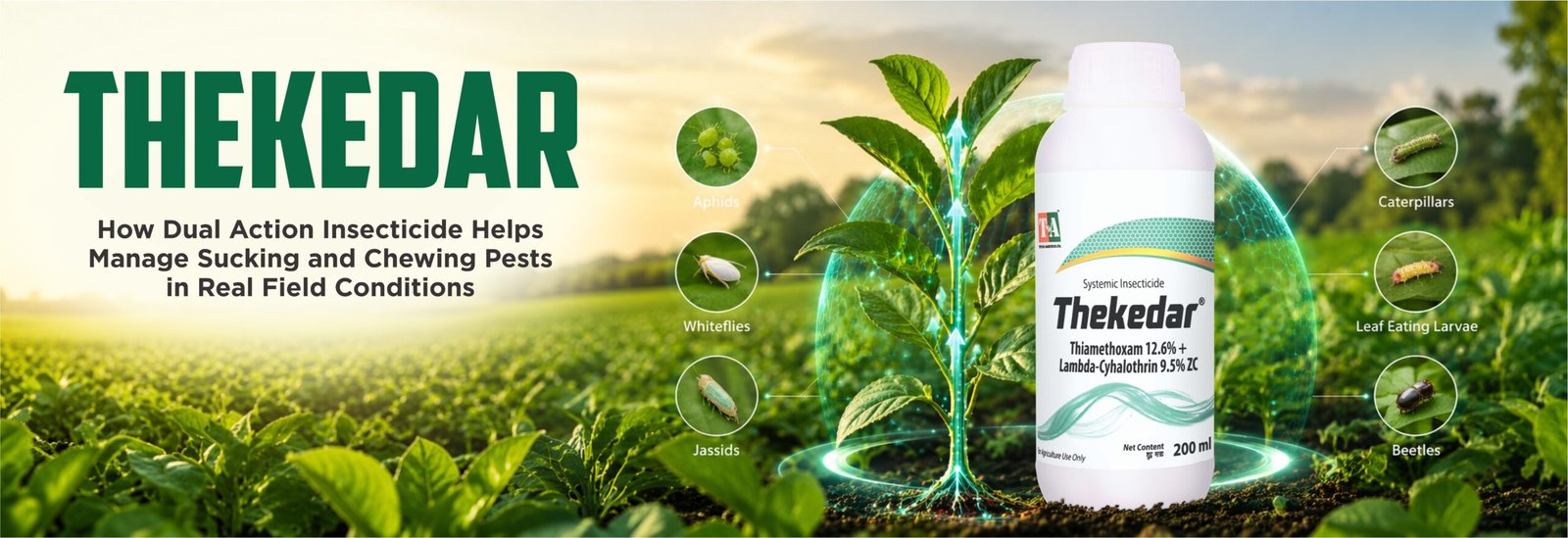
 In practical farming, pest pressure rarely comes in a single form. Most crops face a mixed situation where sap sucking insects slowly weaken the plant from inside, while chewing pests damage leaves and growing points from outside. This combination is what usually pushes the crop into visible stress faster than expected.
When this mixed infestation develops, the challenge is not just pest presence, but how quickly and completely the crop can be protected in a short window. This is where a dual action solution like Thiamethoxam + Lambda Cyhalothrin becomes relevant in field-based crop protection programs.
Understanding real pest pressure in crop fields
Sucking pests such as aphids, jassids, whiteflies, and thrips feed continuously on plant sap. This affects nutrient flow inside the plant and slowly reduces chlorophyll activity. The plant does not collapse immediately, but its growth becomes uneven, leaves lose vigor, and overall development starts weakening.
Chewing pests like caterpillars and borers create direct physical damage. They cut leaf tissue, damage shoots, and in many crops disturb the reproductive structures. Their impact is more visible and often leads to irreversible damage once feeding progresses.
When both pest groups are active together, single-action insecticides often fail to provide complete control because they target only one type of pest behavior.
Why dual action chemistry becomes important in such situations
THEKEDAR is designed on a dual mode approach, where two different chemistries work together in a complementary way instead of relying on a single mechanism.
Thiamethoxam works systemically. After application, it moves within the plant tissues and protects new growth as well. This makes it effective against hidden sucking pests that may not be directly exposed to spray droplets.
Lambda Cyhalothrin works through contact and ingestion. It acts quickly on exposed insects and provides fast knockdown, especially against chewing pests that actively feed on leaves and shoots.
When these two actions operate together, the crop gets layered protection. One action works internally through plant movement, while the other works externally on pest contact.
What this means in actual field conditions
In practical terms, the system works in two directions at the same time.
Sucking pests feeding on plant sap gradually stop feeding as the systemic activity spreads inside the plant. Their population growth slows down, and further spread is reduced.
Chewing pests coming in direct contact with treated surfaces show immediate effect, reducing visible damage on leaves and shoots within a short period after application.
This combined action is especially useful during active crop growth stages where both types of pests are commonly present together.
Why timing of application makes a real difference
The performance of any insect control program depends heavily on timing. Early application at the initial stage of infestation generally gives stronger control compared to delayed spraying after pest populations have already expanded.
In crops like cotton, paddy, vegetables, and pulses, regular field monitoring is important. Once pest activity crosses initial threshold levels, a single well-timed application of a dual action product can help stabilize the situation before it escalates.
At the same time, unnecessary repeated sprays do not improve results and can reduce overall efficiency. That is why field observation plays a key role in deciding spray timing.
Resistance management advantage in modern agriculture
One of the growing challenges in pest control is resistance development. When the same type of chemistry is used repeatedly, pests gradually adapt, and control effectiveness reduces over time.
A combination of two different modes of action helps slow down this process. Thiamethoxam affects the nervous signaling system in sucking pests, while Lambda Cyhalothrin acts on sodium channel function in insects. Because both target pests differently, the adaptation process becomes slower compared to single mode products.
For long term effectiveness, rotation with other chemical groups is still important in a structured pest management program.
Crop safety and field performance balance
A well-formulated ZC formulation ensures proper spreading and adherence on leaf surfaces. This helps improve coverage uniformity and reduces losses due to wash-off during irrigation or light rainfall.
When used at recommended dosage, the crop remains protected without disturbing normal plant growth activity. Healthy plants maintain better photosynthetic performance, which supports yield formation during critical growth stages.
Where THEKEDAR fits in a real farming program
In practical crop protection planning, products like THEKEDAR are most useful when:
- Mixed pest pressure is visible in the field
- Early signs of sucking and chewing pests appear together
- Rapid crop recovery is needed during active growth stages
- Farmers want one solution instead of multiple separate sprays
It is not about replacing all insecticides, but about simplifying and strengthening control when multiple pest types are active at the same time.
Conclusion
In real agricultural conditions, pest management is not about controlling a single insect type. It is about managing overlapping infestations within limited time and crop stages.
A dual action combination like Thiamethoxam + Lambda Cyhalothrin works because it addresses both sides of the problem simultaneously, internal feeding pests and external damaging pests.
This is why such formulations are increasingly used in modern crop protection programs where speed, coverage, and reliability of control matter more than single-target action alone.