 Vegetable cultivation is one of the most intensive forms of farming, where crop health directly influences both yield and market value. Unlike many field crops, vegetables are harvested for their edible portions, whether leaves, fruits, pods, or stems. This makes them highly vulnerable to insect damage because even minor feeding injury can reduce marketability and affect profitability.
Among the various challenges faced by vegetable growers, lepidopteran pests such as fruit borers, pod borers, leaf-eating caterpillars, and other chewing insects remain some of the most destructive. These pests not only feed on foliage but also attack flowers, fruits, and growing points, causing direct economic losses throughout the crop cycle.
Managing these pests effectively requires more than simply reducing insect numbers. Modern crop protection focuses on interrupting the pest life cycle, minimizing crop damage, and maintaining healthy crop growth during critical developmental stages.
Understanding the Pest Challenge in Vegetable Crops
Vegetable crops provide an ideal environment for insect development. Tender foliage, continuous flushing of new growth, and favorable microclimatic conditions allow pest populations to multiply rapidly.
Caterpillar pests are particularly damaging because their feeding behavior causes immediate and visible injury. Young larvae often begin by scraping leaf surfaces, but as they mature, they consume larger portions of plant tissue and may bore into fruits, pods, and shoots.
In crops such as tomato, chilli, okra, brinjal, cabbage, cauliflower, and other vegetables, pest infestations can escalate quickly if not managed at an early stage. Once larvae enter fruits or protected plant parts, control becomes significantly more difficult.
The challenge becomes even greater because different life stages of the pest often exist simultaneously within the field. Eggs, young larvae, mature larvae, and pupae may all be present at the same time, requiring a management approach that targets multiple stages of development.
Why Combination Insecticides Matter
Effective pest management increasingly relies on combinations of active ingredients that work through different mechanisms.
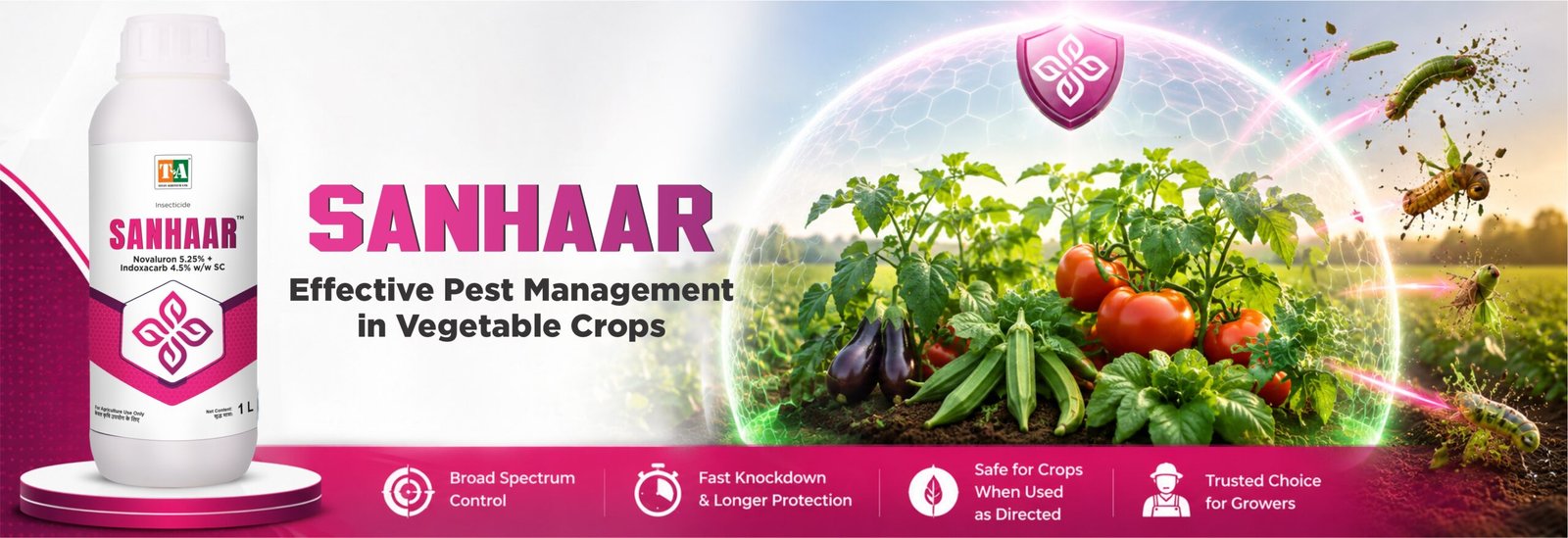
SANHAAR combines Novaluron 5.25% and Indoxacarb 4.5% SC, creating a dual-action approach against chewing pests.
Novaluron belongs to the insect growth regulator (IGR) category. It primarily affects the development of immature insect stages by interfering with chitin synthesis, a critical component of the insect exoskeleton. As a result, larvae are unable to complete normal molting processes, disrupting their life cycle and reducing future pest populations.
Indoxacarb works differently. It affects the insect nervous system by blocking sodium channels, causing feeding cessation and eventual mortality. Because feeding stops quickly after exposure, crop damage is significantly reduced even before complete pest mortality occurs.
The combination provides both immediate suppression of active feeding pests and longer-term interruption of pest population development.
How SANHAAR Works in Field Conditions
In practical farming situations, pest control is most successful when it addresses both present and future infestations.
When caterpillars attack vegetable crops, the immediate concern is stopping active feeding. Every day of uncontrolled feeding can result in increased damage to leaves, flowers, and marketable produce.
The Indoxacarb component helps address this challenge by rapidly affecting feeding behavior. Once exposed, larvae reduce feeding activity, limiting further crop injury.
At the same time, Novaluron targets developing immature stages within the pest population. By disrupting molting and development, it reduces the number of larvae that successfully progress through their life cycle.
This dual mode of action creates a broader and more sustainable control strategy than relying solely on contact knockdown products.
Importance of Early Intervention
One of the most important principles in vegetable pest management is timely action.
Many caterpillar species cause relatively little damage during the earliest stages of infestation. However, as larvae grow, their feeding capacity increases dramatically. A mature caterpillar can consume many times more plant tissue than a newly hatched larva.
For this reason, management is most effective when pest populations are targeted during their early developmental stages.
Regular field scouting helps identify infestations before economic damage becomes severe. Monitoring egg masses, young larvae, and early feeding symptoms allows growers to intervene before pest populations become difficult to manage.
Early intervention not only improves control efficiency but also helps reduce the number of applications required during the season.
Protecting Yield and Crop Quality
In vegetable crops, insect damage affects more than yield alone.
Feeding injury on leaves reduces photosynthetic capacity, limiting the plant’s ability to produce and transport carbohydrates. Damage to flowers can reduce fruit set, while injury to developing fruits directly affects quality and market acceptance.
Fruit boring pests are especially problematic because even small entry holes can make produce unmarketable. Secondary infections by bacteria and fungi often develop through feeding wounds, further increasing losses.
Effective pest management therefore contributes not only to higher production but also to better quality, appearance, and market value of harvested produce.
Resistance Management Benefits
The repeated use of a single insecticide chemistry increases the risk of resistance development within pest populations.
Combination products help address this challenge by exposing insects to multiple modes of action simultaneously. Because different biological pathways are targeted, the likelihood of pests developing resistance rapidly is reduced.
Novaluron and Indoxacarb work through entirely different mechanisms, making the combination valuable within structured resistance management programs.
However, long-term resistance management still requires proper rotation with other insecticide groups and adherence to recommended application practices.
Role in Integrated Pest Management
Modern vegetable farming increasingly follows Integrated Pest Management (IPM) principles that combine chemical, biological, and cultural control strategies.
Within these systems, insecticides are used as one component of a broader management program that may also include:
1. Field sanitation to remove pest reservoirs.
2. Regular monitoring and threshold-based decision making.
3. Conservation of beneficial insects where possible.
4. Balanced fertilization to avoid excessive vegetative growth that favors pest multiplication.
5. Crop rotation and proper residue management.
When combined with these practices, insecticide performance becomes more reliable and sustainable.
Conclusion
Vegetable crops face continuous pressure from chewing pests that can rapidly reduce yield and market quality if left unmanaged. Because these insects damage leaves, flowers, shoots, pods, and fruits, effective control requires both rapid suppression and long-term population management.
SANHAAR (Novaluron 5.25% + Indoxacarb 4.5% SC) combines two complementary modes of action that help manage active feeding larvae while also disrupting future pest development. This dual approach supports better crop protection during critical growth stages and helps reduce the overall impact of caterpillar infestations.
When integrated into a well-planned pest management program, SANHAAR helps growers protect crop health, preserve marketable yield, and maintain more consistent production throughout the vegetable growing season.