
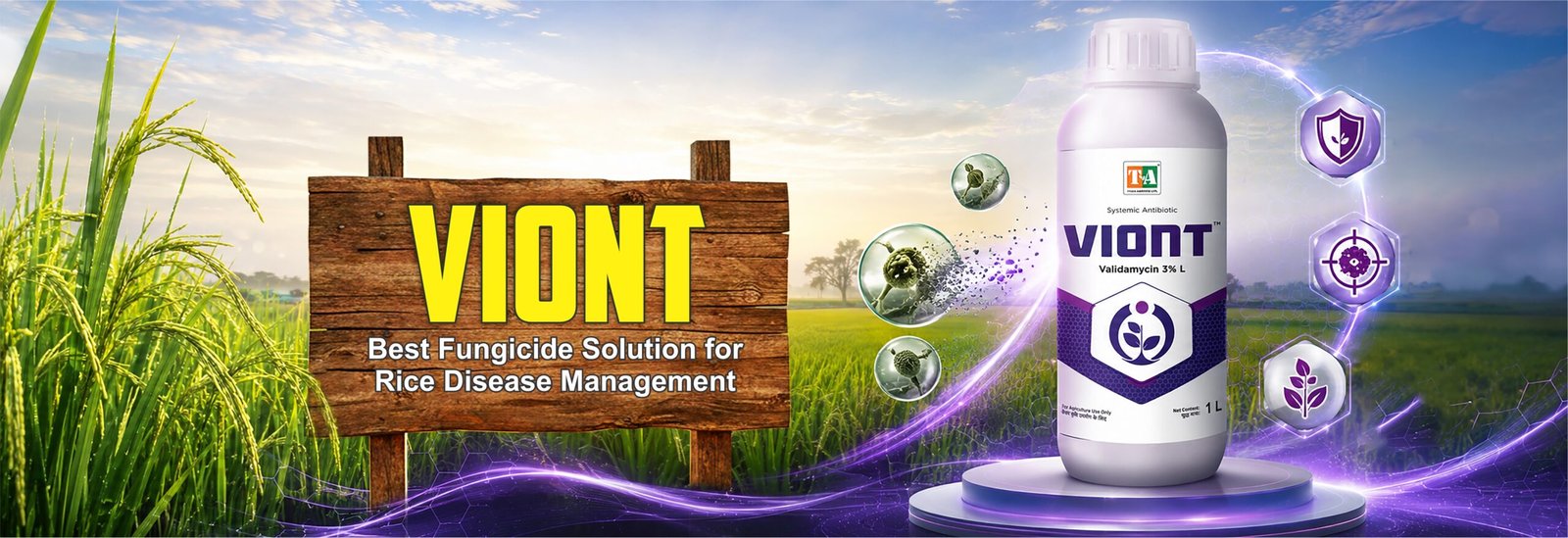
 Rice cultivation constantly faces fungal disease pressure, especially under warm and humid conditions. Dense canopy, standing water, and high nitrogen nutrition create an environment where fungal pathogens develop and spread rapidly inside the crop.
Among the most common diseases, sheath blight and blast consistently affect productivity. Sheath blight, caused by the fungus Rhizoctonia solani, is one of the most destructive diseases in rice. Under favorable conditions such as high humidity, dense canopy, and high nitrogen levels, it can reduce rice yield by around 20% to 50%. In highly susceptible varieties or during severe epidemic situations, losses can reach up to 70%. The disease typically starts at the lower leaf sheath and gradually moves upward. By the time symptoms become clearly visible, infection is already well established inside the canopy.
Rice blast behaves more aggressively under changing weather conditions. It can affect leaves, nodes, and panicles, and in severe cases it directly reduces effective grain formation within a short time window.
Role of VIONT (Validamycin 3% L) in rice disease management
VIONT (Validamycin 3% L) is a targeted fungicide used primarily for sheath blight management in rice. It belongs to the antibiotic class of fungicidal compounds and works by interfering with fungal growth processes, especially the development and expansion of hyphae.
In practical field conditions, this means the fungus loses its ability to expand within plant tissues. Once applied at the right stage, it helps slow down lesion development and restrict further spread inside the crop canopy.
The key strength of Validamycin is not broad-spectrum suppression, but targeted control of sheath blight progression at an early stage.
How it works in real field conditions
Sheath blight infection usually begins near the waterline and progresses upward under high humidity conditions. As infection spreads, lesions expand and merge, reducing the active green leaf area of the plant.
When VIONT is applied during early infection, it helps restrict this expansion process. The infected area does not recover, but the spread to healthy tissue is significantly reduced. This allows the plant to retain more functional leaf area for photosynthesis.
Better leaf health directly supports stronger tiller development and improved grain filling during later stages.
In blast-prone conditions, VIONT plays a supportive role as part of a broader disease management program rather than acting as a primary blast control solution.
Importance of timing in application
The effectiveness of VIONT depends heavily on application timing. Early-stage application gives significantly better control compared to late-stage use.
It is most effective when:
- First symptoms of sheath blight appear in the lower canopy
- Humid weather conditions start favoring disease development
- Crop enters active vegetative or early reproductive stage
Once infection spreads extensively and lesions merge, control becomes limited because damaged tissue cannot be reversed.
Role in integrated rice disease management
Rice disease control is not dependent on a single product. It is a combination of resistant varieties, balanced nutrition, proper spacing, and timely fungicide application.
VIONT fits into this system as a targeted intervention tool. Its role is to manage sheath blight pressure at early stages so that the crop can maintain a healthy physiological balance during critical growth phases.
When used correctly, it reduces disease intensity and supports overall crop stability during humid and disease-prone periods.
Crop response and physiological impact
When sheath blight progression is controlled, the plant maintains a higher level of green leaf area. This directly improves photosynthetic efficiency, which is essential for tiller strength, panicle development, and grain filling.
Healthy foliage also improves the plant’s ability to tolerate environmental stress during flowering and grain development stages.
The final impact is not just disease reduction, but better crop performance throughout the growth cycle.
Field conditions affecting performance
The performance of VIONT is closely linked to field conditions such as humidity, canopy density, and water stagnation. High humidity and dense crop stands increase disease pressure, making timely intervention more important.
Uniform spray coverage is critical because sheath blight often develops in lower canopy regions where air movement is limited. Proper penetration of the spray solution ensures better contact with infected areas.
Conclusion
Rice diseases like sheath blight and blast are strongly influenced by weather conditions, crop density, and growth stage. Effective management depends on early detection and timely intervention rather than delayed control after disease spread.
VIONT (Validamycin 3% L) plays a focused role in controlling sheath blight at early stages of infection and helps maintain healthy leaf area during critical growth periods. Its performance is highly dependent on timing and field conditions.
When integrated into a proper rice disease management program, it supports better crop stability, improved physiological health, and more consistent yield formation under disease-prone environments.