
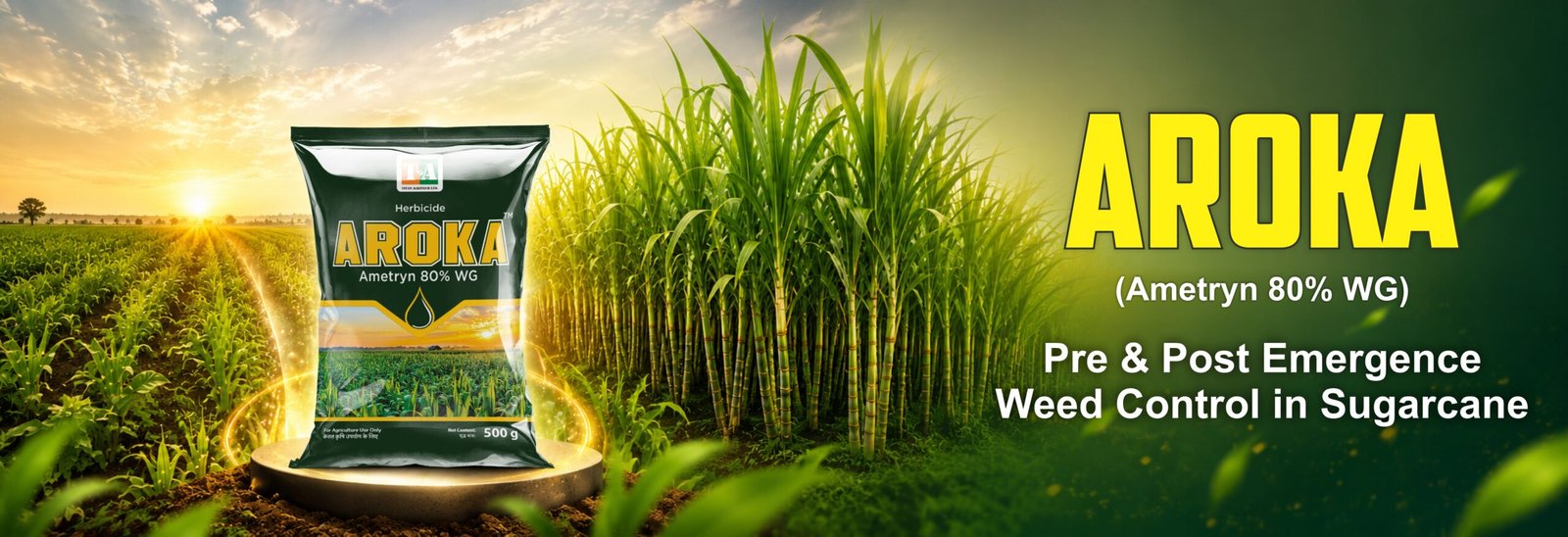
Sugarcane is a long duration crop, and weed management in it is not a one-time operation. The crop stays in the field for many months, and during this period weeds continuously find opportunities to emerge and compete. In the early stage especially, sugarcane grows slowly while weeds establish much faster, which creates strong competition for nutrients, moisture, and sunlight. This early imbalance is the stage where most yield loss actually begins, even before the farmer clearly observes weed dominance in the field.
AROKA (Ametryn 80% WG) is used in this critical early window where weed pressure directly decides how strong the crop establishment will be.
Weed situation in sugarcane fields
Sugarcane fields usually face mixed weed flora. Grasses, sedges, and broadleaf weeds all emerge depending on soil moisture, temperature, and field conditions. This mixed weed pressure makes control more complex because different weed types compete with the crop in different ways.
The most critical phase is the first 30 to 60 days after planting. During this period, sugarcane is still establishing itself and does not have enough canopy strength to suppress weeds. Weeds, on the other hand, grow faster and quickly occupy space, which leads to competition for nutrients and soil moisture.
If this early weed growth is not controlled properly, it directly affects tiller formation, weakens crop vigor, and reduces the uniformity of crop growth. Once the crop enters later stages and canopy starts closing, natural suppression improves, but the early damage cannot be fully recovered.
Why early weed control decides final yield?
The final productivity of sugarcane is strongly influenced by how clean the field remains during the initial growth phase. In the early stage, the crop is biologically weak in terms of competition, while weeds are highly aggressive in utilization of resources.
When weeds dominate during this stage, the crop suffers in multiple ways. Tiller formation becomes uneven, plant growth slows down, and early vigor development is reduced. These early setbacks eventually reflect in reduced cane weight and lower yield potential at harvest.
Even if weeds are controlled later, the crop cannot fully regain the growth advantage lost in the early phase. This is why early weed control is considered a decisive factor rather than a supportive practice in sugarcane cultivation.
How AROKA works in pre emergence conditions?
Pre-emergence application is done after planting but before weed seeds germinate. In this stage, Ametryn creates an active layer in the upper soil zone where weed germination normally begins.
When weed seeds start sprouting, they come in contact with this active zone. At this point, Ametryn interferes with the early metabolic process of the weed, especially photosynthesis. As a result, the weed seedlings fail to establish properly and the first major weed flush is controlled before it becomes visible above the soil surface.
This early control is important because the first weed flush is usually the most aggressive and sets the foundation for further weed infestation pressure in the field.
Early post emergence control in real field situations
In practical field conditions, weed emergence is not uniform. Some weeds germinate early along with crop emergence and begin competing with young sugarcane plants.
AROKA also provides control in early post emergence situations when weeds are still in their initial growth stage. At this stage, the herbicide is absorbed through the green tissues of young weeds and gradually affects their internal growth processes.
The visible effect appears as yellowing of leaves, slow growth, and gradual weakening of the plant. Over time, the weed loses its ability to compete and dies off depending on species sensitivity and growth stage.
However, performance at this stage is highly dependent on weed age. Younger weeds respond more effectively, while older or well-established weeds become harder to control and may require integrated management approaches.
Why Sugarcane requires early weed suppression
Sugarcane has a naturally slow initial growth phase compared to weeds. This creates a biological disadvantage in early weeks where weeds can easily dominate available resources.
During this stage, weeds do not only compete for nutrients but also reduce soil moisture availability and interfere with proper root and tiller development of the crop. Once sugarcane enters active vegetative growth and canopy starts closing, it naturally suppresses weed growth, but this advantage only develops after the early phase is managed properly.
This makes early weed suppression a necessary part of crop establishment rather than an optional intervention.
Field performance depends on application conditions
The effectiveness of Ametryn in sugarcane is closely linked to field conditions at the time of application. Soil moisture plays a key role in activating pre-emergence herbicide behavior. If soil is dry, herbicide activation becomes slower and weed control efficiency may reduce.
In post emergence situations, weed stage and leaf condition are equally important. Young and actively growing weeds show better response compared to mature weeds. Uniform spray coverage also ensures consistent performance across the field.
These factors together decide the actual field outcome rather than the product alone.
Crop safety and practical use considerations
Sugarcane generally shows good tolerance to Ametryn when it is used at recommended dosage and correct timing. However, soil texture, organic matter content, and environmental conditions can influence herbicide behavior in different fields.
Proper application ensures that weed suppression is achieved without affecting normal crop growth. When the crop remains free from early weed stress, it develops better vigor and establishes a stronger growth base for later stages.
Conclusion
Weed control in sugarcane is most effective when managed during the early growth phase of the crop. Once weeds establish strongly, control becomes difficult and crop recovery is limited.
AROKA (Ametryn 80% WG) fits into this system as an early stage weed management tool that helps control both germinating weeds and young emerging weeds. Its effectiveness depends strongly on timing, soil moisture, and weed stage, which means correct field application practices are essential for consistent results.
When used as part of a planned sugarcane weed management program, it helps reduce early competition and supports stronger crop establishment, which ultimately influences overall crop performance.