
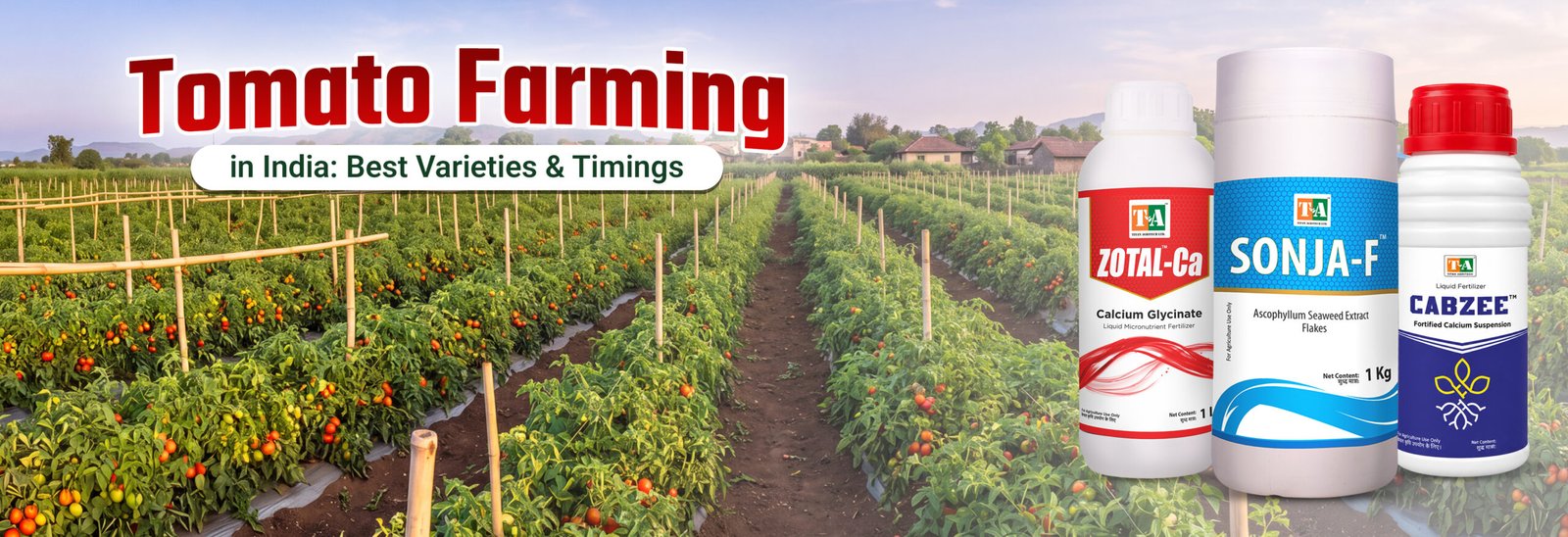
Tomato Farming in India: 9 Best Cultivation Practices
Tomatoes are a very popular vegetable to grow throughout India. They can be used in food production, sauces, ketchups, soups and much more. Due to the high demand within the local community and food industry, growing tomatoes can be an excellent money earner. In order to get a good yield of tomatoes, it is important to grow a suitable variety, at the right time, ensuring adequate watering/feeding. Also protecting them from pests and disease.
Tomato farming is very sensitive. If the temperature, water levels and nutrients are not stable, then problems may occur with the growth. Issues such as flower drop, deformed fruits, uneven ripening and reduced marketable yield may occur. Understanding how to successfully grow tomatoes will allow you to make informed choices. This will help produce healthy plants.
Overview of Tomato Farming
Tomato (Solanum lycopersicum) is a species of the Solanaceae family grown in almost every major agricultural area of India. The area of tomato production is important, among others, in Maharashtra, Karnataka, Andhra Pradesh, Madhya Pradesh, Uttar Pradesh, Bihar, Odisha, and Gujarat.
This could be cultivated in several seasons depending on the climate of the region and the variety selected. Open fields provide some farmers with growing tomatoes; others opt for polyhouse or net-house cultivation in order to regulate weather conditions and stretch the harvest season. Tomatoes are commonly found in varying shapes, sizes, and colors. Some types develop a very dense fruit best for transport, while others are more suitable for consumption fresh or in processed form. Therefore, the first important step is to choose in accordance with the type of crops for the local market.
Climate Conditions for Tomato Farming
- Ideal temperatures for tomato farming would be between 20-28 degrees Celsius.
- Night time temperatures should be between 15-20 degrees Celsius to aid fruit setting.
- Over 32 degrees celsius can cause issues with pollination.
- Low temperatures and frost can cause damage to the plants.
- Plenty of sunlight will aid the plants in growing in good quality.
- If the temperatures are too high during flower development, then flowers can drop without producing any fruits. If it is very cloudy and humid for long periods of time, then there can be increased disease pressure.
Soil Requirements
Tomato farming can be grown in a range of soils but are generally best suited to well-draining sandy loams and loams high in organic matter. The soil pH should be around 6.0-7.0. Avoid poorly draining areas, as these can cause damage to roots and increase the risk of soil-borne diseases.
Farmers should have a soil test done prior to planting to determine the nutrient levels and decide on appropriate fertilizer options.
Determinate or Indeterminate Varieties
Determinate:
Determinate tomato plants have a short growing season and produce most fruits in a short period of time. Therefore, Tomato farming are often selected for growing in open conditions and with mass harvesting.
Indeterminate: These tomato plants will continue to grow and produce both flowers and fruits for a longer period of time. To grow properly, they must be supported, trained, and pruned correctly. Tomato farming are commonly grown in protected environments.
Best Time for Tomato Farming in India:
Depending on the region, the time is altered. It also depends on the climatic conditions, temperature, and availability of irrigation facilities in that particular region.
Note: The exact date of raising seedlings and transplanting tomatoes may vary. Hence, refer to your local agricultural university/Krishi Vigyan Kendra for the best time.
| Region | Nursery Sowing Period | General Transplanting Period |
| South India | July–August for rainy-season crops; October–November for winter crops | August; November–December |
| North India | May–June and November–December | June–July and December–January |
| Central and Western India | June–July and September–November | July–August and October–December |
| Eastern India | June–July and October–November | July–August and November–December |
| Hilly Region | March–April, depending on altitude | April–May |
Step-by-Step Tomato Cultivation Practices
1. Land Preparation for Tomato Farming
Prepared land (free of weed and previous crop residues) with incorporation of well-decomposed organic manure and Fabiana (1 L/acre). If the area is prone to water logging, then raised beds can be prepared.
2. Nursery preparation and transplanting
Tomatoes can be grown by the transplanting method. Healthy seeds should be used. Seedlings can be grown in raised beds or pro-trays with good drainage. Maintain the right humidity conditions. Protect seedlings from heavy rain and insect attack.
Before sowing, seeds can be treated with 5-10 g of TRICHO-PEP H and PSEUDO-PEP. Seedlings can be transplanted after 4-6 weeks of sowing. Transplant in evenings or on cloudy days to reduce stress. Apply light irrigation. Space seedlings as per variety and growth type.
3. Irrigation
Tomatoes require regular moisture in the soil. First irrigation should be applied right after transplanting. Subsequent irrigations should be done depending upon the type of soil, climate, and growth stage.
Uniform moisture levels can be achieved within the rhizosphere using drip irrigation. Avoid excess irrigation. Sudden changes in moisture may lead to split fruits.
4. Fertilization
CABZEE (Fortified Calcium Suspension): Helps in flowering, fruiting, and better fruit quality by supplying calcium, zinc, and boron.
SONJA F : Helps in vegetative, flowering, and crop development.
ZOTAL-CA : Supplies Chelated calcium to improve calcium nutrition during fruit development.
5. Weed control & cultural practices
Remove weeds by timely weeding & hoeing. Application of mulch will help retain moisture, reduce weeds, and give more stability in the root zone.
Staking and training are recommended in a variety of indeterminate varieties to support better growth of plants, better air circulation, and ease of harvesting.
6. Common Tomato Pests and Their Management
| Pest | Symptoms | Control |
| Whitefly | Sapping on plant, leaf curl virus | PEPMIDA-17 (Imidaclopide 17.8% SL) This is a systemic insecticide. It disrupts the nervous system of insects to help control white fly. Apply at a rate of 60-70 ml per acre.
|
| Thrips | Silvery spots, deformed leaves | ICHCHA (Fipronil 40% + Imidaclopide 40%) A mix of 2 insecticides, with differing modes of action. They interfere with the insect nervous system. Apply at a rate of 30-40 g per acre. |
| Fruit borer | Holes in fruits and injury in fruits | SPINOVOLT (Spinosad 45% SC) Contact and stomach action. Interferes with insect nervous system to help control feeding larvae. Apply at a rate of 50 ml per acre. |
| Leaf miner | Tunnels or mines inside leaves | NIIMPA 10000 (Azadirachtin 1% (10000PPM)) Antifeedant and insect growth regulator. Disrupts feeding and development in insect pests. Apply at a rate of 2.6ml per litre of water. |
| Spider mites | Fine webs, yellow and bronze coloration in leaves | AVARRA (Abamectin 1.9% EC) Translaminar action. Disrupts mite nervous system to reduce feeding and numbers. Apply at a rate of 0.75ml per litre of water. |
7. Common Tomato Farming Diseases and Their Management
| Disease | Symptoms | Control |
| Early Blight | Brown circular lesions on older leaves. | DIZOXY (Azoxystrobin 18.2%, Difenoconazole 11.4% SC) Systemic protection with two active ingredients to assist control of early blight. Apply at a rate of 200ml per acre. |
| Late Blight | Water-soaked dark lesions on leaves and stem. | DIZOXY (Azoxystrobin 18.2%, Difenoconazole 11.4% SC) Systemic protection with two active ingredients to assist control of early blight. Apply at a rate of 200ml per acre. |
| Bacterial Wilt | Wilting of plants even under proper soil moisture levels. Brown discoloration may be observed in the stem. | TRICHO-PEP H LIQUID (Trichoderma harzianum 2.0% AS)
Introduces beneficial fungal species into the rhizosphere to provide biological control within the rhizosphere. Apply at a rate of 2 L per acre. |
| Root Knot | Tumors are formed on the root system, resulting in reduced uptake of nutrients and water. | NEMEXA (Paecilomyces lilacinus 1.50% LF) Beneficial fungus that attacks nematode eggs to assist with nematode control in the rhizosphere. Apply at a rate of 2.5L per acre. |
| Damping-off | Rotting of seedling at ground level leading to falling of plant. The seedling will finally die. | PEPTILIS (Bacillus subtilis 1.5% AS)
Beneficial bacteria to suppress soil-borne pathogens that are susceptible to biological antagonism. Improves seedling establishment. Apply at a rate of 2L per acre. |
8. Physiological Problems in Tomato farming
Physiological problems can occur due to incorrect watering, nutritional deficiency, or abnormal environmental conditions. Pesticides or fungicides will be ineffective. Correct watering and nutritional requirements should be provided.
Blossom End Rot: Brown, leathery spots can appear at the bottom of fruits due to a lack of calcium. Even soil moisture should be maintained. Calcium can be added using products such as CABZEE and ZOTAL-CA.
Cracking: Cracks can develop in fruits due to rapid change in soil moisture. Regular watering should be carried out, and overwatering following dry conditions should be avoided.
Petal drop: Petals may drop due to temperature, moisture, or overapplication of nitrogen. Balanced nutrition should be provided, and even soil moisture levels should be provided.
Sunburn: White/yellow patches may appear on fruits that are too exposed to the sun. Healthy leaf cover should be maintained.
Uneven ripening: Green/yellow patches may appear due to temperature extremes or nutritional imbalances. Balanced nutrition should be given, and moisture should be even.
9. Harvesting
Depending on variety and growing conditions, tomatoes can be harvested 70-100 days after transplanting. Depending on market requirements, tomatoes should be harvested as follows:
Mature green tomatoes for long distance markets
Pink or pale red tomatoes for near-distance markets
Red ripe tomatoes for local markets or processing.
Be careful when harvesting. Remove bruised and spoiled tomatoes and sort into sizes. Tomatoes should be packed in clean, well ventilated boxes to avoid bruising.
Yield Depending on the variety, time of year, crop management, and growing conditions, a yield of between 15 and 30 tons can be obtained per acre. If a crop is properly irrigated, fed and protected, it will produce high-quality fruits.
Conclusion:
Growing successful tomato farming can be achieved by choosing appropriate varieties for planting, ensuring that crops are planted at the right point during the year, and by providing appropriate irrigation and nutrition.
It is very important to carefully manage flowering, fruit set, and fruit development. These can be greatly affected by environmental temperatures, water shortages, and nutritional imbalances. Monitoring regularly can allow pests, disease, and physiological problems to be identified early.
If regionally appropriate growing methods are adopted, alongside integrated crop management strategies, healthier tomato plants can be produced. This results in improved quality of fruits and increased marketable yield.