
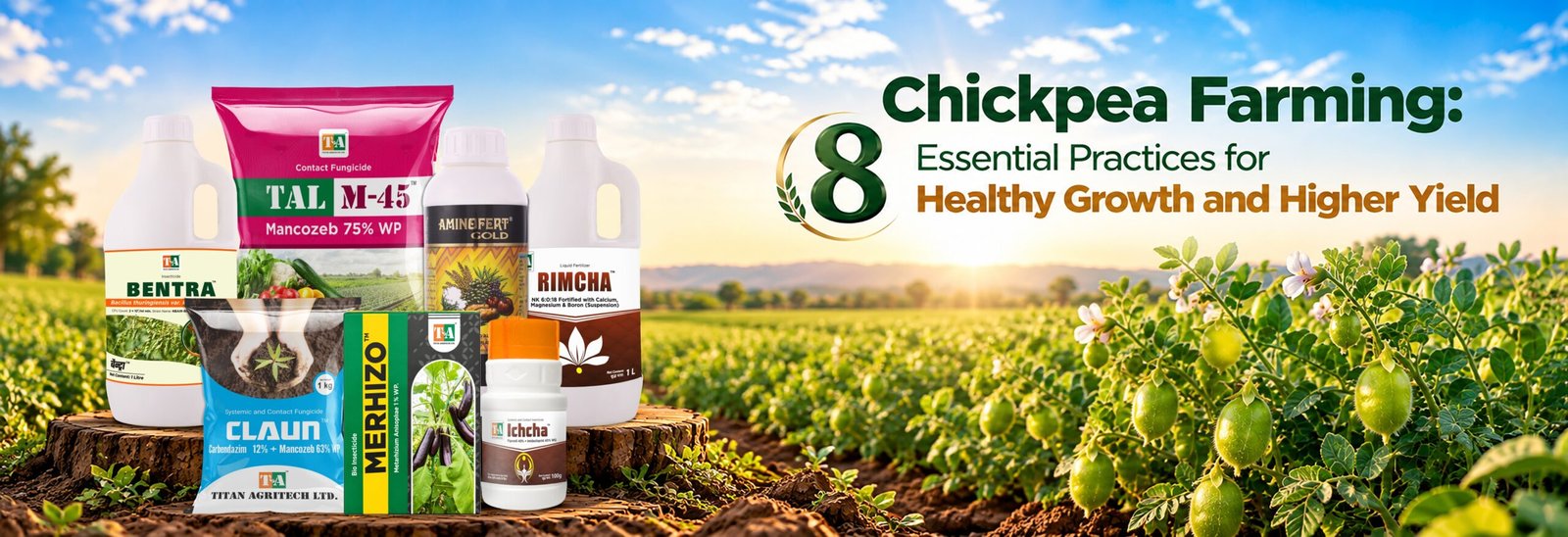
Chickpea Farming is an important part of India’s rabi season because chickpea, also known as gram or Bengal gram, is one of the country’s major pulse crops. It is widely grown for human consumption and is also used as animal feed. Green chickpea leaves are consumed as a vegetable, while the crop straw is used as nutritious fodder for cattle.
India is one of the world’s leading chickpea producing countries. Madhya Pradesh, Rajasthan, Maharashtra, Uttar Pradesh, Karnataka and Andhra Pradesh are among the important chickpea growing states. Chickpea is mainly divided into two groups, Desi gram and Kabuli gram. Desi varieties generally have smaller, brown or dark coloured seeds, while Kabuli varieties produce larger, cream coloured seeds.
Successful chickpea farming depends on choosing a suitable variety, preparing the field properly, sowing at the right time, managing nutrients and irrigation, and protecting the crop from weeds, insects and diseases.
1. Choose the Right Climate for Chickpea Farming
Chickpea is a cool season crop that generally performs well under moderate temperatures during vegetative growth and relatively dry conditions during maturity. A temperature range of around 24°C to 30°C is mentioned as a general growing range, although the optimum temperature varies with the variety and growth stage. Suitable sowing conditions are particularly important for uniform germination and early root development.
Chickpea farming can be grown under rainfed conditions because the crop can use residual soil moisture. However, excessive rainfall, prolonged humidity and waterlogging can increase the risk of root diseases and other crop problems. During flowering and pod development, farmers should monitor the crop for moisture stress. Excessive heat during these stages can affect flower retention, pod formation and grain filling.
2. Select Suitable Soil and Prepare the Field Properly
Chickpea farming can grow in different soil types, but sandy loam to clay loam soil is generally suitable for its cultivation. The soil should retain enough moisture for crop growth while allowing excess water to drain away. Waterlogged fields are unsuitable because standing water can damage roots and increase the risk of soil borne diseases. Saline and alkaline soils may also restrict crop growth. A soil pH of around 5.5 to 7.0 is mentioned as a suitable range, although local soil conditions and variety requirements should also be considered.
Land Preparation for Chickpea Farming
Good land preparation creates a suitable seedbed for uniform germination and healthy root development. Plough the field according to soil conditions, followed by two to three ploughings and planking, where required. The final seedbed should be fine, level, well prepared, and properly drained. Large soil clods should be broken before sowing.
As part of the crop establishment programme, FABIANA (Bio NPK Liquid) at 1 liter/acre can be included in the biofertilizer programme. Crop Tiger at 2 kg/acre can also be used as part of a crop growth support programme.
BAYANI (potash derived from rhodophytes) at 48 g/acre can be included in a potash-based nutrition program where potassium supplementation is required according to crop and soil conditions.
3. Follow the Right Sowing Time, Spacing and Seed Rate
Timely sowing is one of the most important practices in chickpea farming. Early sowing may encourage excessive vegetative growth under some conditions, while delayed sowing can reduce root development and expose the crop to higher temperatures during flowering and pod formation.
General sowing windows are
Rainfed conditions: October 10 to October 25.
Irrigated conditions: October 25 to November 10.
These periods may vary according to location, variety, previous crop and local agricultural recommendations.
Maintain approximately 30 to 40 cm between rows and 10 cm between plants. A sowing depth of around 5 to 8 cm is commonly used, depending on soil moisture and soil type. The deeper 10 to 12.5 cm depth mentioned in some recommendations should not be followed automatically, as excessive sowing depth can affect emergence.
Recommended Seed Rate
The seed rate depends on the type of chickpea and the sowing method.
Chickpea type General seed rate
Desi Gram 15 to 18 kg per acre
Kabuli gram Around 37 kg per acre
4. Seed Treatment
Seed treatment is an important step before sowing. It helps protect the seed and supports better establishment during the early stages of crop growth. For biological seed treatment, TRICHO-PEP V and PSEUDO-PEP can be used at around 5 to 10 g per kg of seed, according to product recommendations and compatibility.
Proper seed treatment gives the crop a better start and helps establish beneficial microbial support around the seed and developing root zone.
5. Manage Fertilizers and Nutrition for Healthy Growth
Chickpeas are legumes that fix nitrogen through root nodules. However, balanced nutrition, especially phosphorus, is essential for healthy root development and nodulation.
A general fertilizer recommendation may include 13 kg urea and 50 kg SSP per acre. The exact dose depends on soil fertility, variety, and local agricultural recommendations. Always follow soil test results for effective nutrient management.
6. Nutritional Support for Chickpea
YURVA, NPK 11:11:8 with Zinc & Boron, can be included in a balanced chickpea nutrition program to support nutrient availability and crop growth.
RIMCHA, fortified with Calcium, Magnesium & Boron, can be considered where secondary and micronutrient supplementation is required.
AMINOFERT GOLD provides amino acids and peptides and can be included in a crop nutrition program to support plant growth and nutrient utilization.
Apply these products according to the chickpea growth stage, field conditions, product label recommendations, and recommended dose.
7. Manage Irrigation
Water management and crop protection are essential for healthy chickpea growth. Although chickpea is relatively drought tolerant, moisture stress during flowering and pod development can affect yield.
Irrigation Management
Where irrigation is available, pre-sowing irrigation may help ensure adequate soil moisture for germination. Subsequent irrigation should be planned according to soil moisture, rainfall and crop stage.
Two important stages for irrigation are:
- Pre-flowering: Adequate moisture supports flowering and crop development.
- Pod development: Water availability supports pod growth and grain filling.
Pest and Disease Management
Pest Management
| Pest | Symptoms | Management |
|---|---|---|
| Termites | Roots and lower plant parts are damaged. Plants may dry out and can be pulled from the soil easily. | ICHCHA (Fipronil 40% + Imidacloprid 40% WG) – 25 gm/acre |
| Cutworms | Caterpillars hide in the soil and cut seedlings or stems near ground level. | MERHIZO (Metarhizium anisopliae 1% W.P.) – 1 kg/acre |
| Gram pod borer (Helicoverpa armigera) | Caterpillars feed on leaves, flowers, and green pods. Circular holes may appear on pods as larvae feed on developing grains. | Bentra (Bacillus thuringiensis var. kurstaki (BTK) 10% WS) – 1 liter/acre |
Disease Management
| Disease | Symptoms | Management |
|---|---|---|
| Ascochyta blight | Brown spots may appear on leaves, stems, branches, and pods. Severe infection can damage large portions of the plant. | TAL M-45 (Mancozeb 75% WP) – 600–800 gm/acre |
| Grey mould | Water-soaked spots develop on leaves, followed by brown or dead tissue. Severe infection may affect stems, flowers, and branches. | CLAUN (Carbendazim 12% + Mancozeb 63% WP) – 700 gm/acre |
| Rust | Small brown pustules appear, often on the lower surface of leaves. Severe infection may cause premature leaf drop. | HIKSA-5 (Hexaconazole 5% SC) – 200–400 ml/acre |
| Wilt and root rot | Plants may lose their normal green color, turn yellow, wilt, and eventually dry out. Root damage may be visible when affected plants are uprooted. | TOSEM 70 (Thiophanate Methyl 70% WP) – 280 gm/acre |
8. Harvest Chickpea at the Right Stage for Better Yield and Quality
Timely harvesting helps maintain grain quality, reduce post-harvest losses, and protect the yield obtained from the field. Chickpeas are generally ready for harvesting when the plants turn yellow to reddish-brown, most leaves dry and fall, and the pods reach maturity. Harvesting time may vary depending on the variety and growing conditions.
Cut the mature plants using a sickle or a suitable harvesting method. Dry the harvested plants in the sun for around five to six days, weather permitting, before threshing. Ensure the grains are adequately dried before storage to help prevent moisture-related damage.
Expected Yield:
Chickpea yield varies with variety, soil fertility, rainfall, irrigation, and crop management. Under favourable conditions, a yield of approximately 4–8 quintals per acre may be achievable, though actual results can vary.