
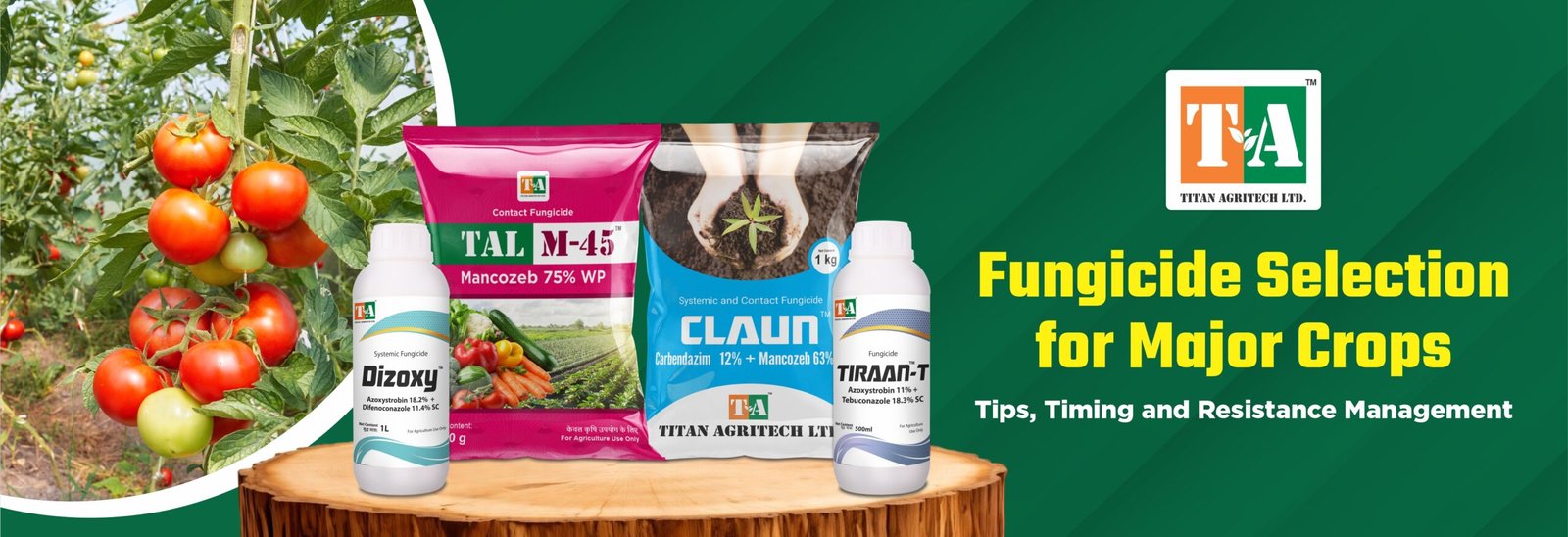
Tips, Timing and Resistance Management
Crop diseases are one of the biggest reasons behind yield loss in farming. Many times farmers notice spots on leaves or drying of plants, but by the time action is taken, the damage is already done. This is where proper fungicide selection becomes important. A good crop disease treatment guide is not just about choosing a product, it is about understanding timing, crop stage and disease pressure.
Why Fungicide Selection Matters
Every fungal disease behaves differently. Some spread quickly in humid weather, while others develop slowly and damage crops over time. Because of this, using the same fungicide for every situation does not work.
Farmers often search for the best fungicide for tomato blight, but the answer depends on when and how the disease appears. Early stage blight needs a different approach compared to severe infection.
Understanding Preventive and Curative Approach
Fungicides mainly work in two ways. Preventive fungicides protect the crop before infection starts. Curative fungicides help stop the disease after it appears.
A proper crop disease treatment guide always focuses more on prevention. Once the disease spreads widely, even the best fungicide gives limited results.
Right Timing of Application
Timing plays a bigger role than the product itself. Many farmers delay spraying and expect quick recovery, but fungal diseases do not work that way.
In crops like tomatoes, early spray is critical. If you are looking for the best fungicide for tomato blight, it should be applied before or just at the start of infection.
Important spray timings include
• Early vegetative stage
• Before humid weather conditions
• At first visible symptoms
Correct timing ensures better protection and reduces repeat sprays.
Fungicide Resistance in Agriculture
One of the biggest challenges today is fungicide resistance in agriculture. When the same fungicide is used again and again, fungi slowly adapt and stop responding.
This means farmers have to use higher doses or more sprays, which increases cost and reduces effectiveness.
Understanding fungicide resistance in agriculture is important for long term crop protection.
How to Manage Resistance
Resistance can be controlled with simple practices
- Rotate fungicides with different modes of action
- Avoid repeated use of the same product
- Use recommended dose only
- Combine with good field practices
A balanced crop disease treatment guide always includes these steps.
Example: Tomato Blight Management
Tomato blight is one of the most common fungal diseases. Farmers often look for the best fungicide for tomato blight, but management should be planned properly.
- Use healthy seedlings
- Maintain proper spacing
- Avoid excess moisture
- Spray fungicides Like TAL M- 45, Tiraan T , Dizoxy, Claun at early stage
When these steps are followed, disease pressure reduces significantly.
Conclusion
Fungicide selection is not just about picking a product, it is about timing, understanding disease and managing resistance.
Farmers looking for the best fungicide for tomato blight should follow a complete crop disease treatment guide instead of relying on a single spray. At the same time, awareness about fungicide resistance in agriculture helps in maintaining long term effectiveness and better crop health.
FAQs
- What is the best fungicide for tomato blight?
There is no single fixed answer. The best fungicide for tomato blight depends on crop stage and disease severity. Early stage preventive sprays usually give better results than late curative sprays. - When should fungicides be applied?
Fungicides should be applied at early crop stage, before favorable weather for disease, or as soon as first symptoms appear. - Why is a crop disease treatment guide important?
A proper crop disease treatment guide helps in selecting the right product, correct timing and proper dose, which improves control and reduces cost. - What is fungicide resistance in agriculture?
Fungicide resistance in agriculture happens when fungi stop responding to a product due to repeated use of the same molecule. - How can farmers prevent fungicide resistance?
By rotating fungicides, using recommended doses, and avoiding repeated use of the same product.